Cloud
Two-Tier ERP with SAP Cloud ERP: One Group, One Close.
– Nov 16, 2026

Your subsidiaries don’t need your headquarters ERP. They need to be readable by it.
The close is an architecture problem
You run a solid SAP core at headquarters. Around it sits a dozen subsidiaries on whatever they were using when you acquired them: a local ERP nobody remembers choosing, three accounting packages, two company codes bolted into the global instance years ago. Every month-end starts by collecting trial balances that were never designed to be added together.
More consolidation tooling at the top will not fix that. The problem lives at the source, in data structures that don’t match.
Architects call the alternative composable ERP: a core, with independently deployable units around it, instead of one global instance every entity must squeeze into.
Two-tier ERP is composability applied at the entity level.
What two-tier ERP with SAP Cloud ERP means
SAP Cloud ERP is SAP’s public cloud ERP offer: multi-tenant software as a service with a clean core by design. Its single-tenant, deeply customizable counterpart is SAP Cloud ERP Private.
SAP’s two-tier model gives each one a different job. Tier 1 is the headquarters ERP, on SAP Cloud ERP Private or an existing ECC or S/4HANA core: more complex, customized, the place where the group differentiates. Tier 2 is the subsidiary ERP, on SAP Cloud ERP: quick to deploy, simple to run, cost effective to keep.
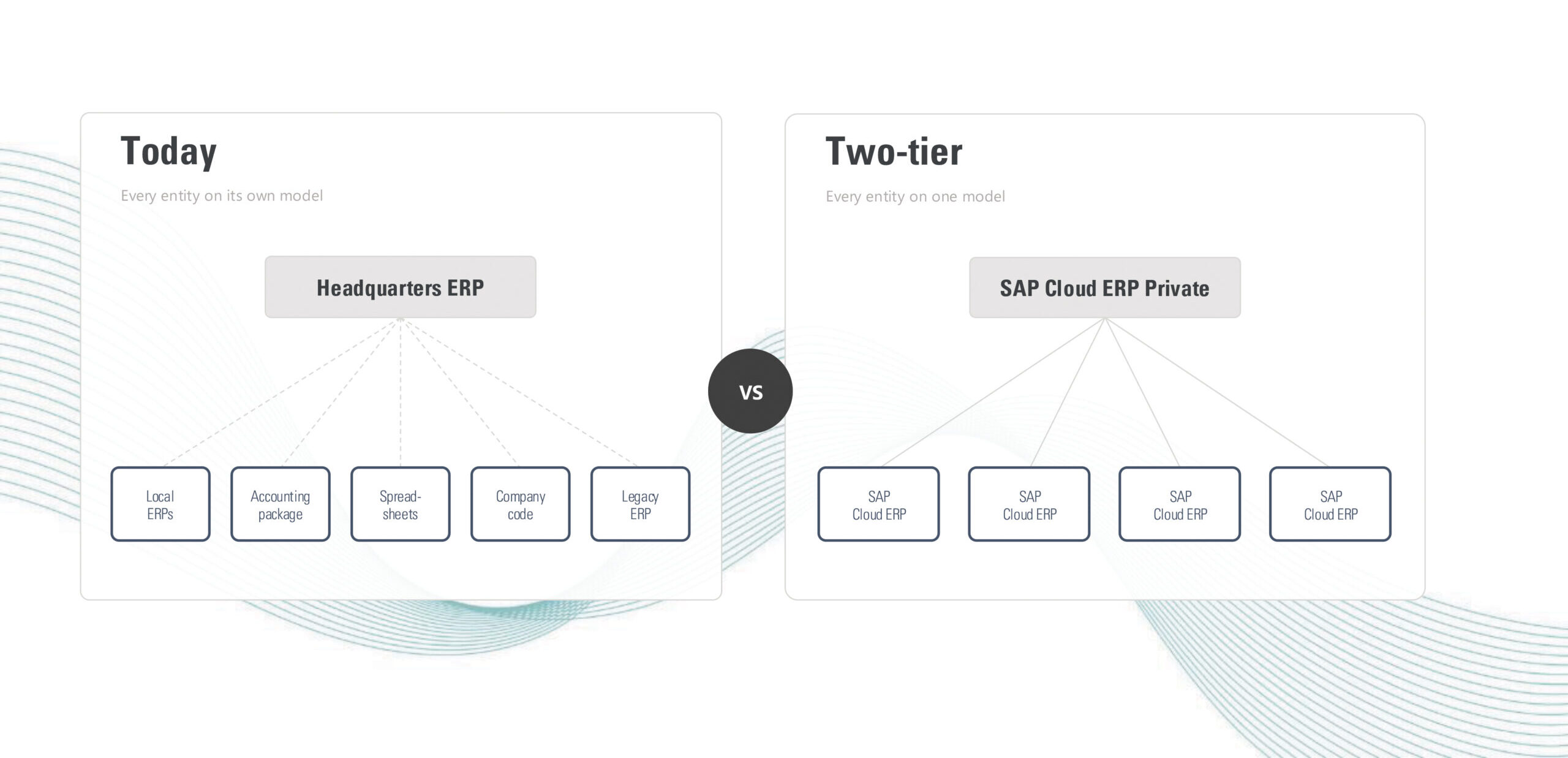
SAP Cloud ERP isn’t a lighter ERP offering. It is a differently governed one. Subsidiaries cannot modify the core, so every entity starts from the same software baseline, the same SAP data semantics and the same delivered chart of accounts template. That baseline is a starting point, not a guarantee: a common chart of accounts, harmonized master data and aligned processes are enforced through the group template, governance and replication, not simply by choosing the same ERP. What the public edition changes is how much room each entity has to drift, which is far less.
The two tiers connect through content SAP already ships: master data replication, subsidiary as sales office, subsidiary as production unit, and sales and procurement flows between tiers, activated through SAP Integration Suite rather than built at every site. SAP Cloud ERP also comes with 60 local versions in 34 languages.
What changes in the consolidated close
SAP Group Reporting at headquarters consolidates on the Universal Journal. A subsidiary on SAP Cloud ERP is still a separate system, so its figures still have to be transferred into Group Reporting through a supported path. What changes is the mapping. Because both tiers share the same S/4HANA accounting model, the semantic translation that consumes most of a traditional close largely disappears. Three transfer paths exist.
- Group Reporting Data Collection. Subsidiaries push financial and non-financial data to SAP BTP, where GRDC maps, transforms and loads it into Group Reporting at headquarters. Works for SAP and non-SAP subsidiaries alike, and it is the usual path for Tier 2.
- Group Reporting APIs. The Tier-2 tenant submits reported financial data directly to headquarters through SAP’s standard APIs and receives confirmations back. Lighter than GRDC when no transformation or manual enrichment is needed.
- Central Finance. Accounting documents replicate in near real time into a Central Finance system at headquarters, which then serves as the single source for consolidation. For continuous visibility, or if you already run Central Finance.
Once subsidiary data is in Group Reporting, intercompany matching and elimination run on standard content rather than on hand-built spreadsheets.
Operational accounting and group consolidation are tightly integrated rather than kept in disconnected reporting stacks: accounting originates in the Universal Journal, while consolidation data, adjustments and eliminations are managed in Group Reporting’s own ledger.
Master data: govern once, consume everywhere
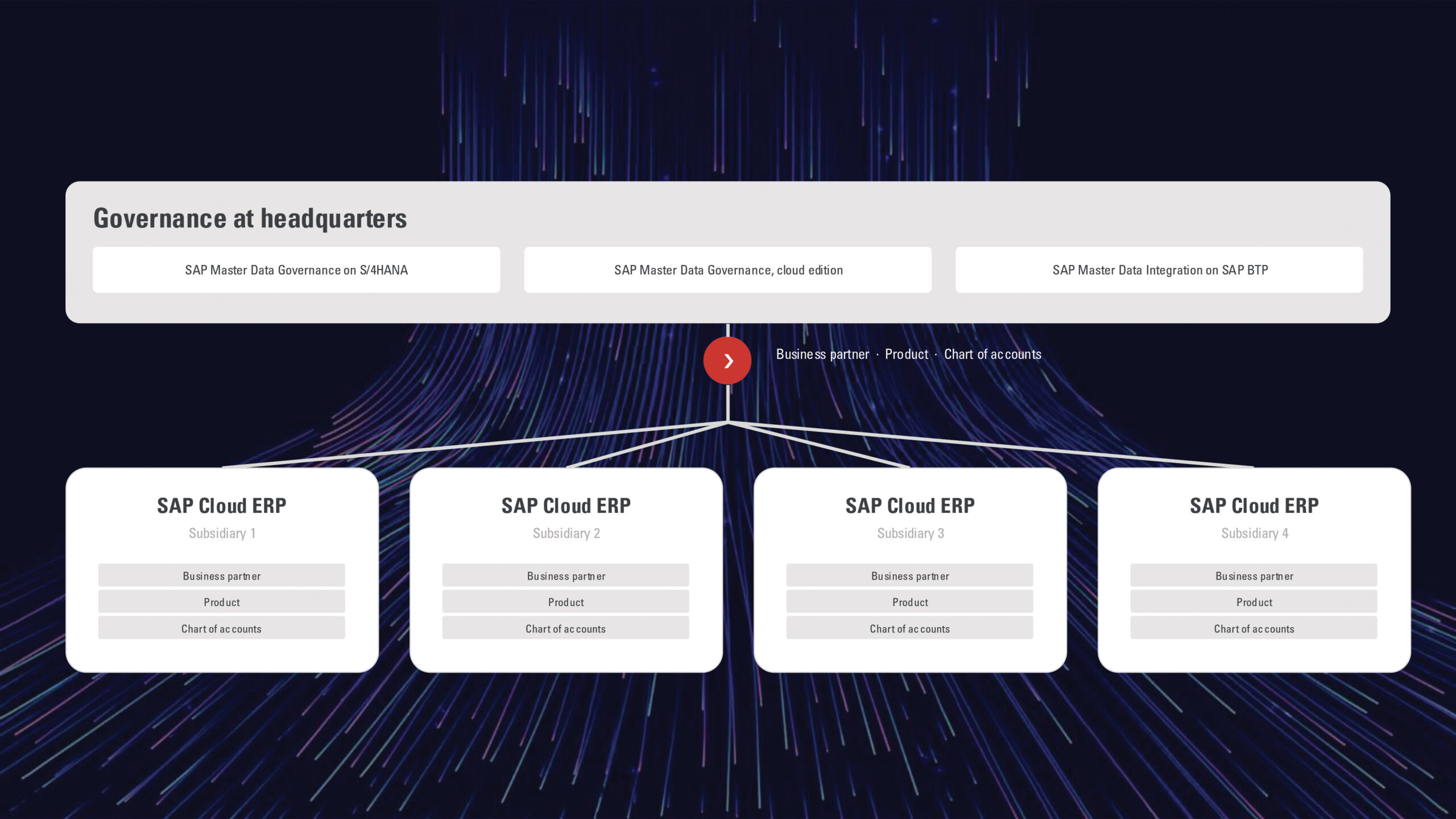
Without governance, customers get duplicated, product hierarchies drift, and group reporting gets harder with every rollout. The principle: govern centrally, consume locally. SAP offers several ways to do it, all compatible with SAP Cloud ERP.
SAP Master Data Integration on SAP BTP distributes master data across tiers on SAP’s One Domain Model.
SAP Master Data Governance, cloud edition adds cloud-native governance for business partners. Inside the tenant itself, SAP S/4HANA Cloud Public Edition, master data governance provides consolidation, duplicate detection, mass processing and data quality for business partner and product data.
And SAP Master Data Governance on S/4HANA at headquarters offers the broadest domain coverage and full central governance, distributing down to every Tier-2 tenant through the Data Replication Framework or APIs, which is SAP’s recommended pattern for this landscape. Subsidiaries can still maintain local fields, such as MRP data, on top of the governed core.
Every acquisition could be a future divestiture
ERP decisions usually get made as if the group’s legal structure were permanent. It rarely is.
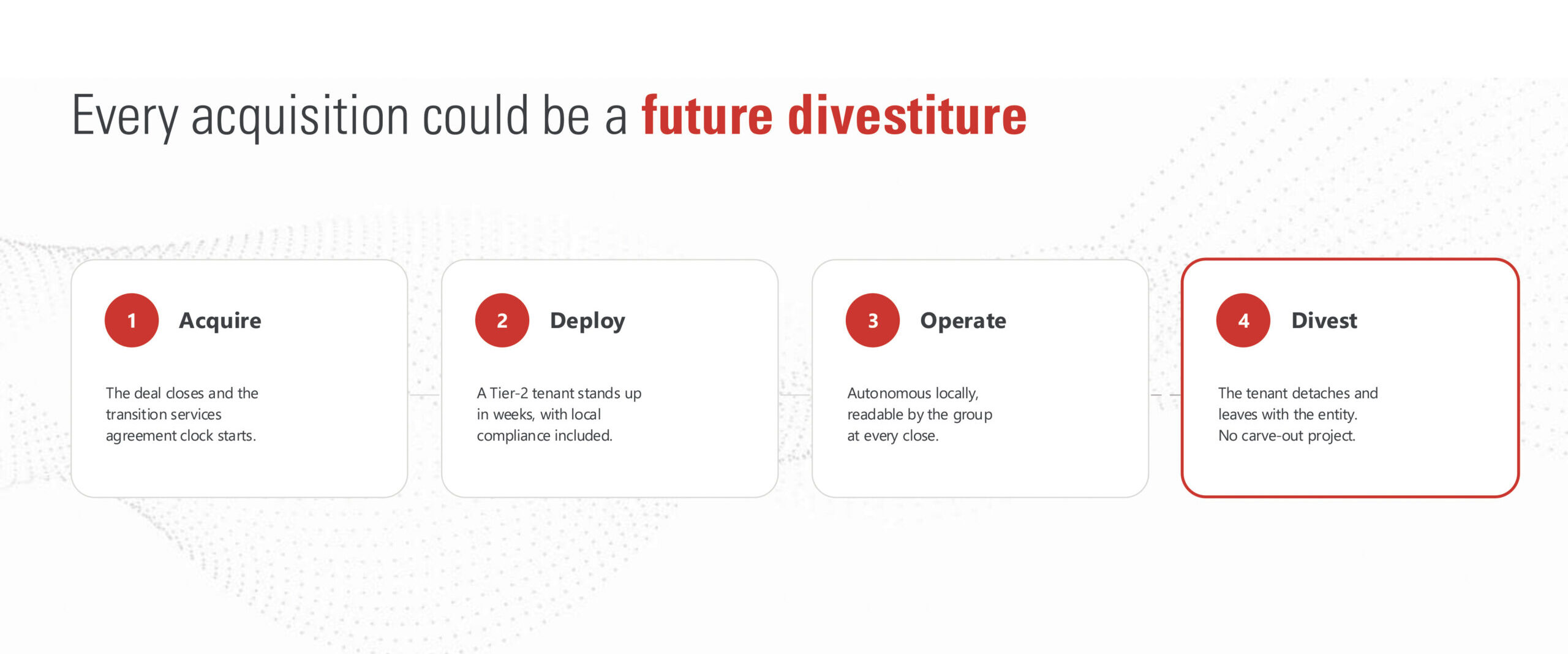
On the way in, you close a deal and the transition services agreement clock starts, billing you monthly for systems you don’t control. A Tier-2 tenant is a landing zone you can stand up in weeks, with local statutory compliance already included. You exit the TSA rather than extend it.
The way out is the part nobody models on day one, and it turns on a deployment choice made on the way in. A public edition system can hold several legal entities as company codes, and for a subsidiary the group intends to keep, that is often the right answer. When a future spin-off is plausible, the recommendation: provision the entity in its own SAP Cloud ERP subscription. That gives it a clean system and contractual boundary from day one, no company code to untangle from forty others in a shared instance, and a subscription that could potentially move to the buyer through a contract ownership transfer agreed with SAP.
The buyer receives a running, supported, standard SAP system rather than a data extract and a migration plan. That is a diligence asset, not a diligence finding, and it shows up in the price.
One core, many entities
An ERP choice made for a subsidiary this year will still be shaping the group close in five years, and the negotiating position if that entity is ever sold. Few groups weigh it that way at the time. The ones that do end up with subsidiaries that are easy to read, easy to consolidate, and easy to let go of.
This works when one partner can carry the subscription, the implementation and the ongoing run of both tiers, the private core and the public subsidiaries. As an SAP PartnerEdge Sell, Build and Service Authorized partner, that is the conversation oXya is set up to have with you.
Frequently asked questions
What is a two-tier ERP strategy?
A two-tier ERP strategy runs two different ERP layers in one group: a customized, feature-rich ERP at headquarters (Tier 1) and a standardized, fast-to-deploy ERP at subsidiaries, sales offices and acquired entities (Tier 2). The tiers are integrated so that group reporting, master data and intercompany processes run on a consistent, shared data model. With SAP, Tier 1 is typically SAP Cloud ERP Private or ECC, and Tier 2 is SAP Cloud ERP.
How does two-tier ERP improve group consolidation?
Because SAP Cloud ERP constrains customization, subsidiaries share the same accounting model and, with group governance, the same chart of accounts and master data. Their financial data is structurally comparable, which removes most semantic mapping. The data still has to be transferred into SAP Group Reporting at headquarters through Group Reporting Data Collection, SAP’s group reporting APIs, or Central Finance document replication, after which standard intercompany elimination and consolidation run centrally.
How is master data governed across two tiers?
The principle is “govern centrally”, “consume locally”. Compatible options include SAP Master Data Integration on SAP BTP for distribution, or SAP Master Data Governance, cloud edition for business partner governance.
How long does it take to deploy SAP Cloud ERP at a subsidiary?
A subsidiary rollout on SAP Cloud ERP typically takes weeks to a few months using SAP Activate and a fit-to-standard approach.
What happens to the ERP if we sell the subsidiary in a two-tier context?
It depends on how the entity was deployed. If the subsidiary was provisioned in its own SAP Cloud ERP subscription, it already has a clean system and contractual boundary, and the subscription can be transferred to the buyer through a contract ownership change agreed with SAP, which shortens the transition services agreement and gives the buyer a running standard SAP system. If it shares an instance with other entities, a carve-out is still required, so the deployment decision should be made with a possible exit in mind.

Other articles


3 SAP Cloud ALM Adoption Mistakes That Put Implementation Value at Risk
Jorge Herrera Abundis
Read more