SAP
A model for the market: oXya’s journey with SAP LeanIX
– Aug 28, 2026

Even when enterprises can confidently list every system they own – applications, databases, systems – challenges remain. Because lists of hardware and software alone don’t give clarity on which capabilities the business can deliver, at what level, and with whom accountable. Making it far too easy for duplication to creep in, decisions to slow down, and investments to fall short of their potential.
An approach called Application Portfolio Management, or APM, aims to change this. It’s a method that treats technology as enabling assets: strategic resources for competitiveness and cost optimization. It’s a natural fit for companies with broad and diverse IT capabilities – a category that includes oXya itself.
This article explores how oXya adopted SAP LeanIX to build an inhouse APM function – expertise we’re now introducing to our customers, too.
Application Portfolio Management: not just the Big Picture, but the Real Picture
APM is fundamentally about building a map of the company’s business capabilities and the applications that deliver them – showing what each piece of software achieves for its owner within the business, whether that’s an improved process, a more competitive cost case, or a more successful client engagement. First, let’s look at the application that does it.
LeanIX: a technology whisperer for the C-Suite
LeanIX is a SaaS-based platform that integrates with app portfolios, cloud providers, databases and so on. It’s been part of the SAP family since 2023. It provides transparency into an organization’s application portfolio, technology stack, and business capabilities, so decisions can be made in confidence.
With an enterprise‑architecture lens, Enterprise Solutions professionals Jacob George and Frederic Fodil represented in LeanIX oXya’s capabilities as the applications that enable them, giving leaders a common, accessible language for understanding enterprise architecture. According to Jacob:
“LeanIX was selected because it fits naturally within the SAP ecosystem while staying business-oriented. Its integration with SAP Cloud ALM means we can discover and structure our own internal landscape – including the systems around our SAP Cloud ERP, which directly supports our GROW journey by making the portfolio visible and governable as we evolve.”
But as an Enterprise Architecture Management tool, LeanIX is only as valuable as the decisions it facilitates. For its users – mainly C-level and leadership – to see genuine value in the platform, the information must be accurate, trusted, and translated into meaningful visibility. So, the team decides on a strategy of engaging stakeholders to get that information, not imposing a model on them.
Designing the project process: putting people first
The oXya team believed that when you want people’s genuine opinions – not “what’s right or wrong”, but “what they think” – informal direct engagement often works. A key job was also teasing out information that’s nuanced and qualitative and that’s often assumed rather than written down. That meant no traditional lengthy workshops or long PowerPoint decks, but instead a series of short, focused stakeholder sessions, mostly 30 minutes or less. Clear questions, concise decisions, and a brief follow-up to confirm alignment created an efficient, repeatable approach that oXya can apply in customer engagement.
Establishing ownership … and owning a few surprises
Understanding who owned each application was a key challenge. An application process may benefit many people, span many involvements, but who is really responsible for it?
In a world of matrix organisations and cross-functional teams, ownership can be difficult to define. Technical ownership isn’t the same as business ownership – or even process ownership, so the project had to identify and confirm the right accountable stakeholders for each application.
How LeanIX made a hard job easier
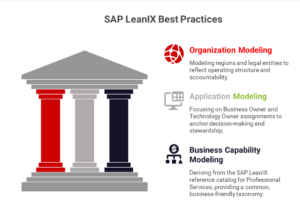
LeanIX proved capable of handling the complexity, prioritizing progress over perfection and following SAP LeanIX best practices. The initial scope involved modeling three core Fact Sheets:
- The Organization factsheet modeled capabilities by regions and legal entities, to reflect operating structure and accountability.
- The Application factsheet focused on Business Owner and Technology Owner assignments, to anchor decision‑making and stewardship.
- The Business Capability factsheet linked applications and capabilities to the SAP LeanIX reference catalog for Professional Services, providing a common, business‑friendly taxonomy.
This foundation created clear traceability from capability – application – owner, so leaders could standardize where it made sense, tolerate necessary variation, and invest with evidence. There were other benefits: as Jacob and the team worked, they found SAP LeanIX brought welcome structure and momentum to the process, saving them time and resources too.
The finishing step was a key outcome of the follow-up meetings: obtain a formal confirmation of application ownership. And meeting by meeting, agreement by agreement, the picture of oXya’s technology capabilities became clear.
A defined model of capabilities: spanning teams, crossing silos
Today, managers from the C-Suite down have a holistic view of business capabilities and who delivers them. Three reports are key:
- The Application Matrix Report shows which organizational units use which applications and which business capabilities those applications enable over time, with additional lenses like business criticality, the Gartner TIME classification (Tolerate/Invest/Migrate/Eliminate) and other stakeholder‑relevant views visible too.
- The Application Portfolio Map shows over- and under-resourcing sorted by different parameters like functional fit and technical fit, “scored” on a matrix of whether those investments are Appropriate, Insufficient, Perfect, or Unreasonable for their purpose.
- The Application Radar shows what’s mission-critical, business-critical, or just nice-to-have, where management can allocate resources to de-risk what matters – all based on well-informed, easy-to-understand models.
Completing the picture, all information is on interactive dashboards, with the factsheets serving as live views of the organization’s applications, interfaces, and business capabilities – enabling confident decision making over whether each application should be tolerated, invested in, migrated elsewhere, or improved with innovation.
oXya now practices what it preaches
Application Portfolio management is especially useful at oXya, which has grown by acquisition and many skills overlap across business units and projects. Today, thanks to the LeanIX project, we have an accurate view of what’s happening across our organization – with all the cost advantages and growth opportunities that implies.
In summary: if leaders can see which capabilities are enabled by which systems and who is accountable for each, they can make informed decisions about investment, rationalisation and transformation. oXya now applies the lessons from its own LeanIX journey to help customers build the same clarity and governance into their application portfolios.
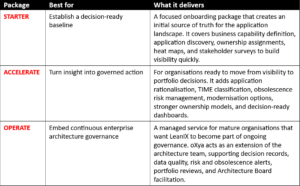
Choose the right level of support for your LeanIX journey
offers three LeanIX service packages designed to match your organisation’s maturity in its APM journey.
Ready to bring clarity and structure to your application landscape?
Talk to oXya about the right SAP LeanIX approach for your organisation:
Other articles

Penetration Testing Companies: What Effective SAP Security Requires
Ozgur Yoral, Global IT Compliance Director & North America CISO
Read more