
A divestiture creates a new legal entity that needs its own systems, its own licences and its own support, usually against a transition services agreement that is already counting down. oXya sizes that separation early, governs it end to end, and runs the new environment once it goes live.
Request a technical assessment
THE TRIGGER
The deal closes on paper long before it closes in the systems
The moment a business unit is sold, its data has to leave a shared SAP landscape and stand up on its own. That work is rarely on the critical path when the deal is priced. It always is by the time the TSA clock starts.
The main challenges
WHAT OXYA DOES
One partner accountable for the whole separation
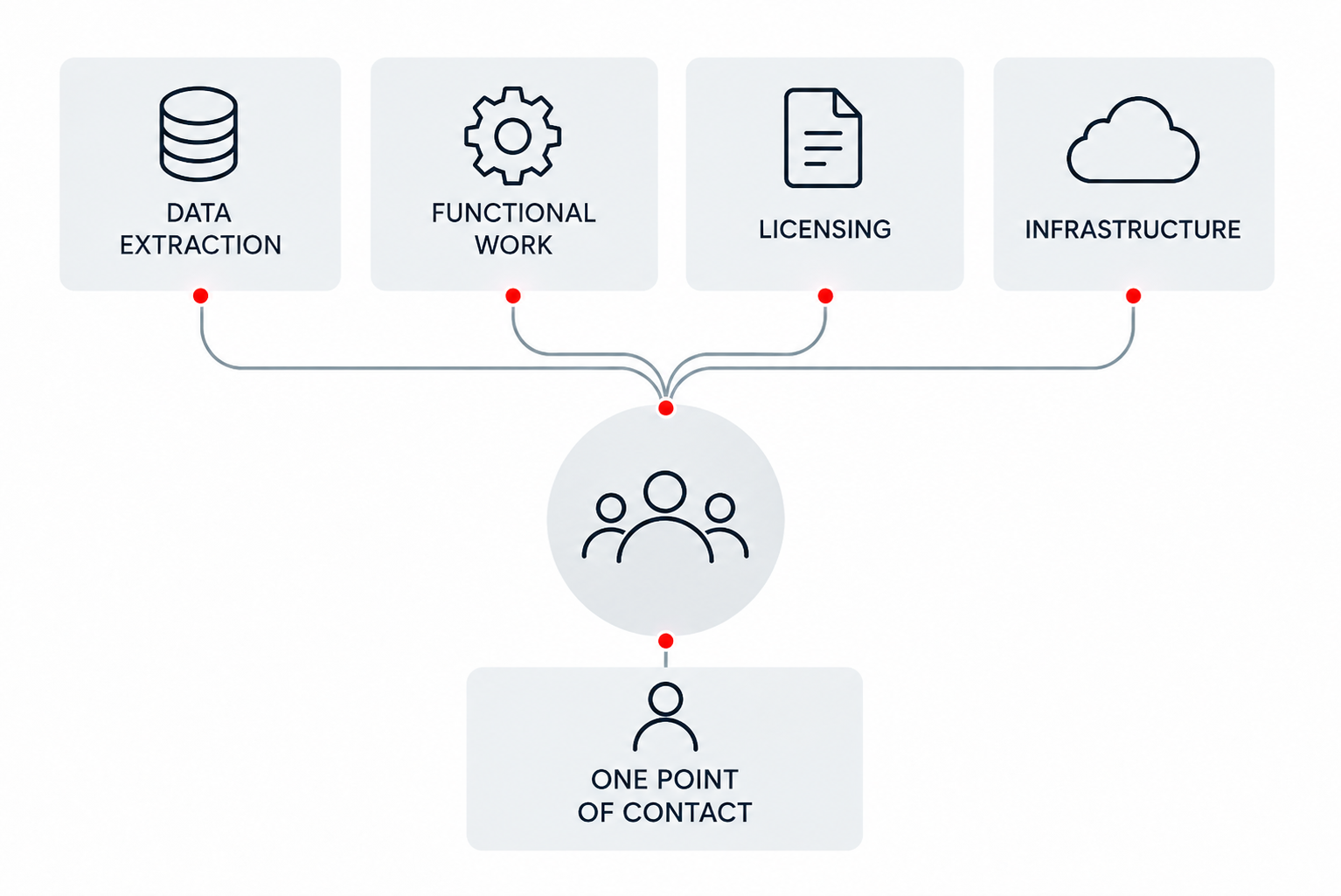
A carve-out is never a single discipline. It takes data extraction, functional work, licensing and infrastructure, usually from different specialists. oXya assembles that group and answers for it, so the new entity signs one contract and holds one party accountable.
The 4 oXya Responsibilities
Early technical assessment
We map the SAP landscape and size the real scope of the separation while the TSA deadlines are still negotiable. Scope discovered later is a schedule problem, and usually a cost one.
A single point of accountability
We select and govern the partners involved in the separation: extraction tooling, functional work and licensing. You deal with oXya; we coordinate the rest.
Licensing for the new entity
We build the SAP bill of materials for the standalone company directly with SAP, so day one is covered contractually as well as technically.
The day after go-live
We host and manage the new landscape as a long-term managed service. The separation project ends; the operating model it leaves behind does not.

TWO VIEWS OF THE SAME PROBLEM
In a divestiture, the SAP separation plan is priced in the deal
Why the technical separation shapes the TSA, the schedule and the cost of the transaction, and what to settle before the deadlines are fixed.
Read the article

Data separation: how SAP carve-out slicing really works
What actually get sliced out of a shared SAP S/4HANA system, where the company code selector stops working, and how every table gets its ruling.
Read the article

START HERE
Find out what your landscape looks like sliced
The assessment is a short, scoped engagement. It gives both sides of a transaction a defensible view of the separation before commitments are locked in.
- Enterprise structure map
Which organizational elements are exclusive to the entity being sold, and which are shared. - Scope and effort
Data volumes, the tables that need a ruling, and what that means for the timeline. - Target and licensing view
What the new entity needs to run on day one, on premises or in the cloud.
Talk to our technical team