Leading U.S. Financial Services Firm
Transforming SAP Landscape with Data Archiving – Enabling Massive Data Reduction and Superior System Performance
I’m thrilled to share the successful completion of a comprehensive SAP Data Archiving project for a major client in the financial services sector. Serving as the Solution Architect on the planning & execution side, my focus was on balancing aggressive data reduction with the stringent compliance requirements unique to the financial industry.
By implementing a tailored ILM (Information Lifecycle Management) strategy, we managed to significantly decrease the database footprint while ensuring that audit-relevant data remained accessible. It was a rewarding challenge to lead the technical planning, execution, optimize system performance, and deliver a leaner, more agile SAP landscape for the client.
Suharsh Anand, Solution Architect, oXya
Challenge
Unchecked data growth in an ECC Production (EP1) system impacting performance. Highvolume financial transactions causing severe database bloat.
Solution
Execution of Phased SAP Data Archiving (Write/Delete/Index). Targeted high-volume financial objects and executed direct system table housekeeping.
Outcome
Significantly reduced database footprint, enforced a strict 10- year retention compliance rule, and maintained seamless, transparent data accessibility for end-users.
A leading U.S.-based financial services organization providing insurance, banking, and investment solutions was facing rapid data growth across its SAP ECC environment. With high volumes of transactional data and strict compliance requirements, the company needed to optimize system performance while maintaining long-term data accessibility.
oXya partnered with this organization to implement a comprehensive SAP data archiving strategy, reducing database footprint, improving system performance, and ensuring seamless access to historical data.
Key Challenges
- Uncontrolled Data Growth in SAP ECC: The company’s SAP ECC production system experienced significant database growth driven by high-volume financial transactions and electronic banking data, leading to performance degradation.
- Performance and User Experience Issues: Large transactional tables slowed system response times and impacted end-user efficiency across business-critical operations.
- Strict Data Retention Requirements: The organization needed to enforce a 10-year data retention policy, requiring a balance between removing data from the active system and preserving accessibility for compliance and audits.
- Rising Infrastructure and Maintenance Costs: The growing SAP database increased storage costs, system maintenance complexity, and operational overhead.
The oXya Solution
oXya deployed a phased SAP data archiving approach tailored to this high-volume financial environment.

Phase 1: Preparation and Discovery
- SAP table analysis and growth monitoring
- Identification of high-volume archiving candidates
- Mapping of archiving objects aligned with business processes
- Definition of data eligibility and retention rules
Phase 2: Execution and Optimization
- Execution of Pre-processing / Write / Delete / Index archiving cycles
- Implementation of monthly deletion runs with adaptive frequency
- Direct system housekeeping to remove obsolete and orphaned data
- Activation of SAP archive infrastructure for seamless user access
This approach is executed through a structured SAP archiving lifecycle, ensuring data is securely archived before being removed from the active system.
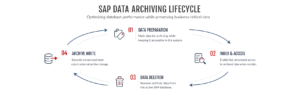
Technologies & Tools Used
oXya leveraged standard SAP tools to ensure precision and scalability:
- SAP SARA – Archive administration and job orchestration
- SAP AOBJ – Archiving object configuration
- SAP DB02 / DB15 – Database monitoring and table mapping
- SAP TAANA – Data analysis and forecasting
This toolset enabled accurate identification, execution, and monitoring of archiving activities.
High-Volume Data Optimization
oXya targeted critical data objects with the highest impact on system performance, including:
- Electronic banking data, including FEBEP tables with approximately 39 million records
- Financial accounting documents, including FI tables
- Payment lock data
- System and change logs
This targeted approach ensured maximum performance gains with minimal disruption.
Data Governance & Compliance
A robust governance framework was implemented to ensure compliance and long-term sustainability:
- Enforcement of a strict 10-year data retention policy
- Use of date-based archiving logic for precise data selection
- Secure storage of archived data in external systems
- Transparent access to archived data through SAP interfaces
Results & Business Impact
- Reduced SAP Database Footprint: Significant reduction in active database size, lowering infrastructure requirements and improving system efficiency.
- Improved System Performance: Faster response times and improved performance for end users across SAP transactions.
- Full Compliance with Data Retention Policies: Successful enforcement of the 10-year retention rule, ensuring audit readiness and regulatory compliance.
- Seamless Access to Archived Data: End users maintained uninterrupted access to historical data via SAP, without awareness of backend storage changes.
- Lower Operational Costs: Reduced storage and maintenance costs, enabling a more efficient and sustainable SAP environment.

Present in 14 states
More than 1,900 employees
- Reduced SAP Database Footprint
- Improved System Performance
- Full Compliance with Data Retention Policies
- Seamless Access to Archived Data
- Lower Operational Costs

At oXya, I had the opportunity to contribute to a SAP Data Archiving project for a finance sector customer as part of their S/4HANA readiness journey. This initiative helped reduce data volume and improve overall system efficiency while ensuring compliance requirements were met.
From a technical standpoint, I was actively involved in executing archiving activities, including write and delete processes, as well as supporting the validation of archived objects in collaboration with functional teams to ensure data integrity and business continuity.
Data archiving is an engaging area that combines detailed technical analysis with thorough functional validation, making it both challenging and rewarding.
I would like to thank Suharsh Anand for his technical expertise, consulting approach, and guidance throughout the project. The customer is very satisfied with the outcome, and I’m glad to have contributed to this successful delivery.
Venu Raparti, Sr. SAP Basis Admin
Looking to Optimize Your SAP Environment?
Discover how oXya’s SAP data archiving and managed cloud services can help reduce costs, improve performance, and ensure compliance.
Why oXya
oXya combines deep SAP technical expertise with a structured, business-aligned methodology to help organizations optimize their SAP environments. For this leading financial services organization, this meant transforming a rapidly growing database into a streamlined, high-performance system—while maintaining compliance and ensuring business continuity.
Other case studies


Benjamin Moore
Crafting cloud resilience for Benjamin Moore Painting a secure future in the cloud with Unisys and oXya

GRTgaz
GRTgaz implements S/4HANA on AWS : how a technical requirement became a business opportunity